
How Newaygo County Deed Records Describe a Transfer
A deed record in Newaygo County names the grantor and grantee, spells out the parcel being conveyed, and identifies the instrument along with the recording act that governs it. Mortgages, liens, assignments, releases, easements, and covenants also appear in these deed records, documenting other rights and burdens attached to the land.
| Deed Type | What It Does | Common Use |
|---|---|---|
| Warranty deed | Conveys with stated covenants | Ordinary sale |
| Quitclaim deed | Conveys whatever interest exists | Family or title cleanup |
| Sheriff's deed | Records foreclosure transfer | Foreclosure result |
| Executor or trustee deed | Conveys under stated authority | Estate or trust |
| Tax deed | Records tax-foreclosure transfer | Completed tax process |
A mortgage, for instance, secures a debt rather than moving fee ownership. A later satisfaction or discharge can release it. An assignment shifts the interest to a new holder. Read the filings in sequence instead of trusting one line. Land contracts, trusts, easements, restrictions, condominium master deeds, surveys, and plats also live in the same land-record system, and their presence can explain a right or a burden without proving anyone became the fee owner.
A solid Newaygo County deed match also needs more than a shared surname. Weigh the recording date, the book-and-page or instrument reference, the document type, and the legal description together. A split parcel, a partial interest, or one lot inside a recorded subdivision can attach a familiar name to entirely different land.
LandWeb Gives Newaygo County Three Proven Search Keys
The LandWeb database is the county's front door for the online deed index. The county lists three search keys. Names work, parcel or Tax ID numbers work, and legal descriptions work too.
| Mode | Input | Use |
|---|---|---|
| Grantor | Seller or transferor name | Find outgoing instruments |
| Grantee | Buyer or recipient name | Find acquisition deeds |
| Tax ID | Parcel number | Match a known parcel |
| Tract | Legal description | Follow lot, block, or land text |
The captured portal shows the public entry surface.
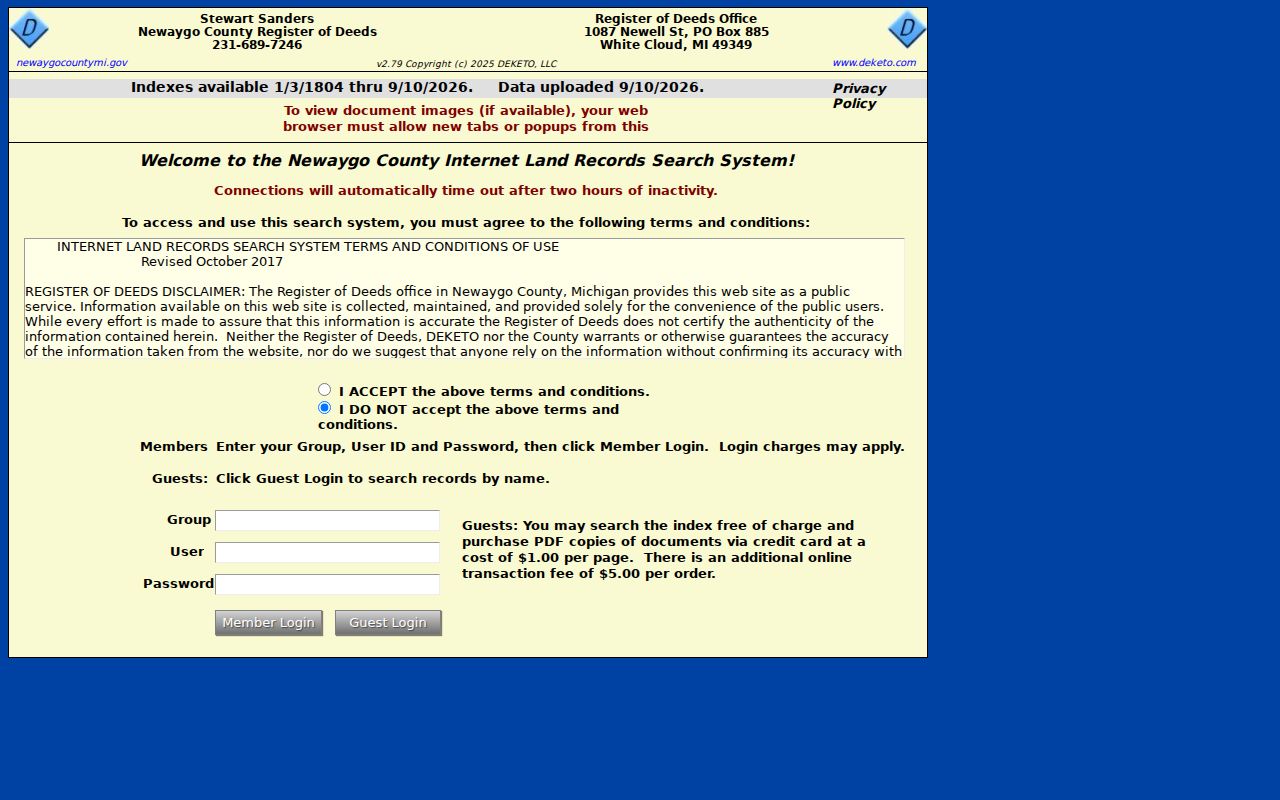
Confirm any exact live filters on the current portal before depending on them.
Newaygo County Deed Books Begin Before the Computer Index
The Register describes a record base reaching from 1840 to the present. Computerized deed records only go back to 1910. Images and indexes are still migrating into the database, with progress into the mid-1910s. Those dates describe two different kinds of access, not a gap in the records.
For anything earlier, carry the last online book, page, party name, and legal description to the deed books or the tract index. Counter searching stands apart from the web system. Staff perform no searches for the public. The Register FAQ confirms that older records exist. A web name search cannot reach them. The county's own office page holds the physical access details.
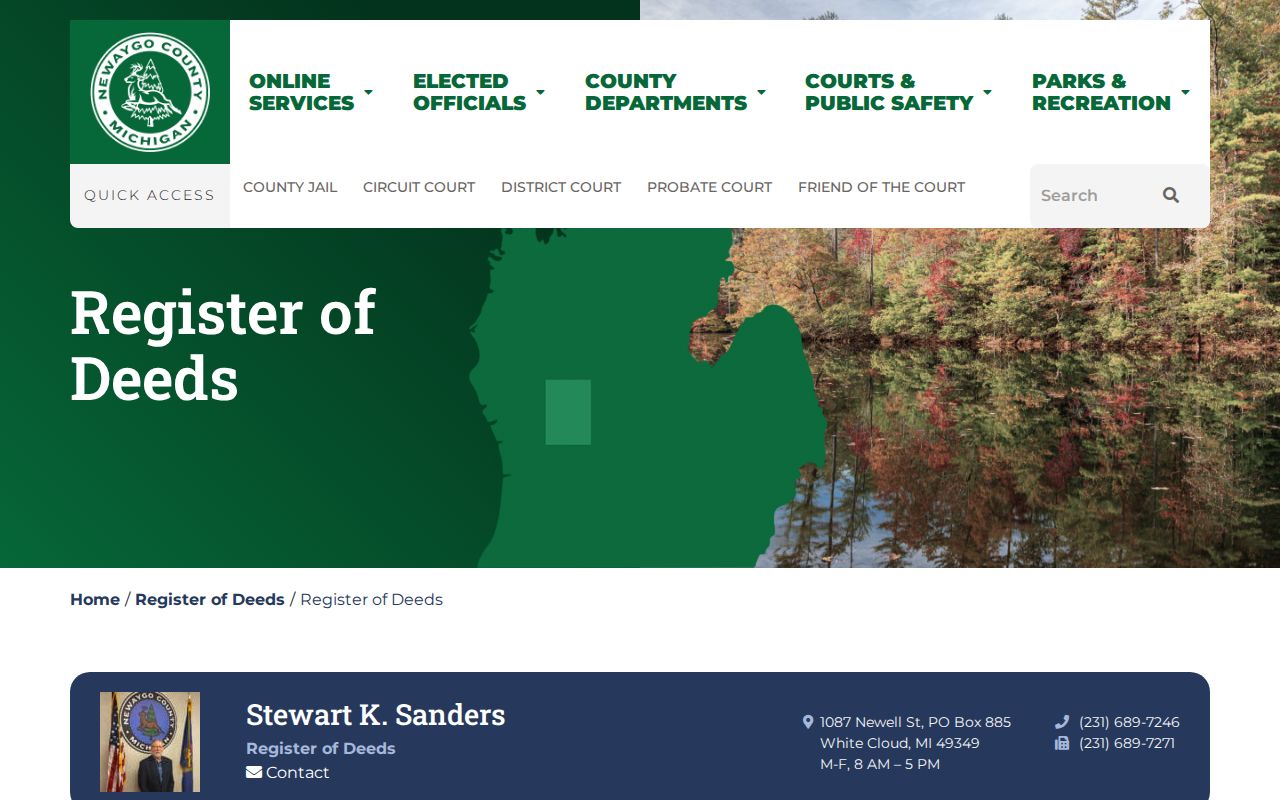
The courthouse counter in White Cloud remains part of a complete deed search, the county's own office page confirms. That is especially true beyond the reach of the computerized index.
Walk the Newaygo County Grantor-Grantee Index
The Register supports searching by party name, by Tax ID or parcel number, and by legal description. The reliable method is to start from one well-matched recent conveyance, then walk backward through each grantor in turn.
- Find the current grantee's acquisition deed.
- Read its grantor and exact legal description.
- Search that grantor as an earlier grantee.
- Repeat while the land description remains consistent.
- Move to deed books when the computer index ends.
- Grantor
- The party transferring the stated interest.
- Grantee
- The party receiving the stated interest.
- Chain of title
- The ordered conveyances tied to the same land.
- Book/page or instrument number
- The recorder reference used to retrieve a filing.
Read Newaygo County Mortgages With Their Releases
A mortgage records a security interest. That is not a conveyance. An assignment can move the interest to a new holder. A discharge, satisfaction, or reconveyance can later release it. Search forward under the parties and compare the recording references. That way an old mortgage is not mistaken for an open one just because its first filing shows up.
Liens and judgments burden land without moving it. Easements, restrictive covenants, master deeds, condominium instruments, surveys, and plats affect rights too. Instrument type and filing sequence matter more than any quick keyword match.
Plats and Legal Descriptions Keep Newaygo County Deeds on the Same Land
Names change. A legal description does not. It persists across much of a Newaygo County deed chain. The county FAQ notes that tract-index searches run on that description. Equalization or the township can help supply it. The GIS map exposes subdivision, lot, block, survey, and long description fields.
GIS lines are reference only. When the physical boundary itself is disputed, the proper sources are a recorded plat or survey. A licensed surveyor settles it. Read the deed page alongside the parcel-map evidence rather than substituting one for the other.
Newaygo County Fraud Alerts Watch Names, Not Title
The Register offers a free fraud-alert service that emails a notice whenever a matching name appears on a newly recorded document. The official form is plain about the limits. Alerts can raise false alarms, and the service neither blocks a filing nor judges whether it is valid.
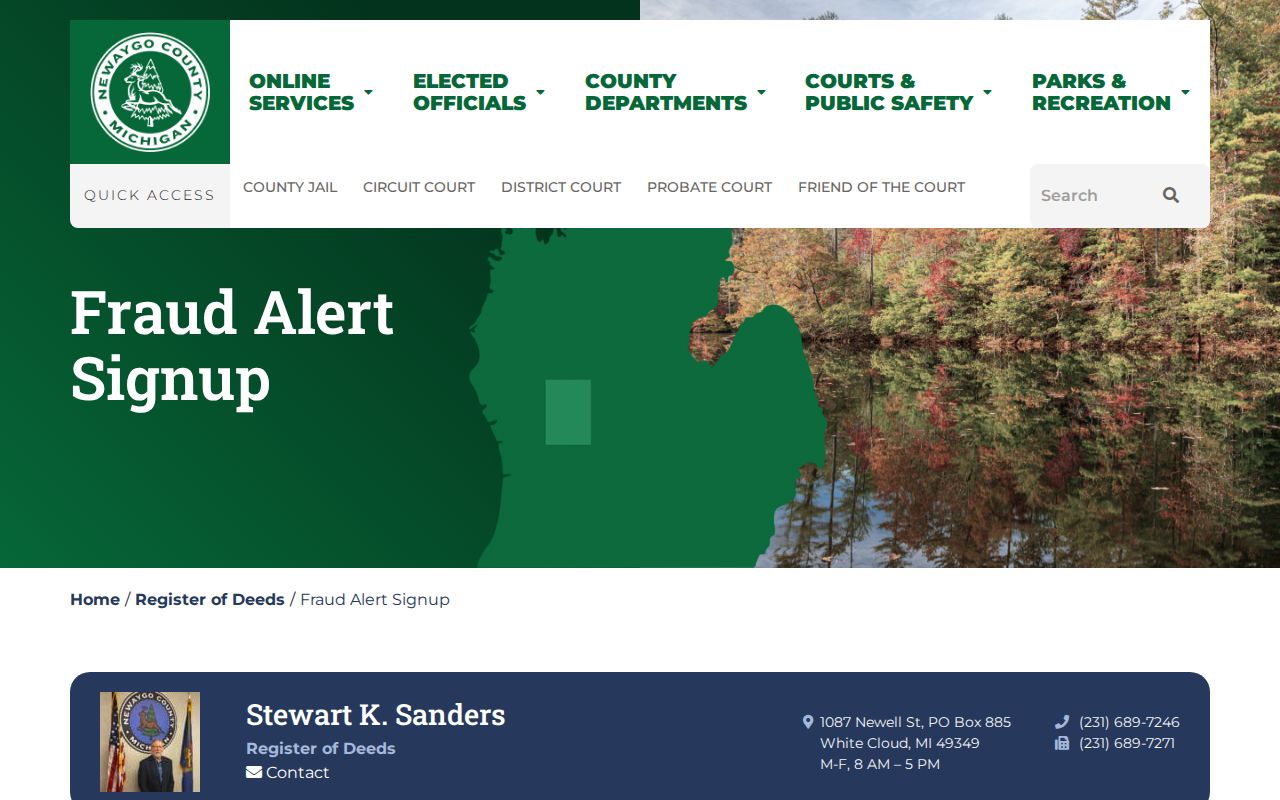
Review the actual instrument before treating an alert as a problem.
Fire and County-Seat History Add Context to Old Newaygo Deeds
History shapes what old Newaygo County deeds look like. An 1883 fire destroyed much of Newaygo. The county seat later moved to White Cloud in 1910. A reference in an old land record may therefore point to a former county-seat setting. It may instead name a historic settlement, a township, or a plat. The legal description and the recorder reference are safer anchors than any modern postal city.
The Library of Michigan guide lists newspapers and county histories that add people-and-place context. The Archives of Michigan also holds old assessment, probate, rural property, and naturalization material. These sources explain a chain. They never replace its recorded deeds.
Published holdings include newspapers from Fremont, Newaygo, Grant, and White Cloud. They also include an 1884 state-census index, early marriages, and a naturalization-card file. Such records can separate people who shared a name and can explain an estate transfer. Rural property files from 1936 through 1942 supply more land context. Tax rolls from the 1850s do the same. Treat each one as a bridge back to the recorded instrument, never as a substitute.
Obtain a Newaygo County Deed Through Three Channels
Searching the index is free. Viewing images online starts with a $5 card charge, and copies run $1 per page under MCL 600.2567(1)(b), with the purchased image emailed after payment approval. The county document-search page explains the online image gate.
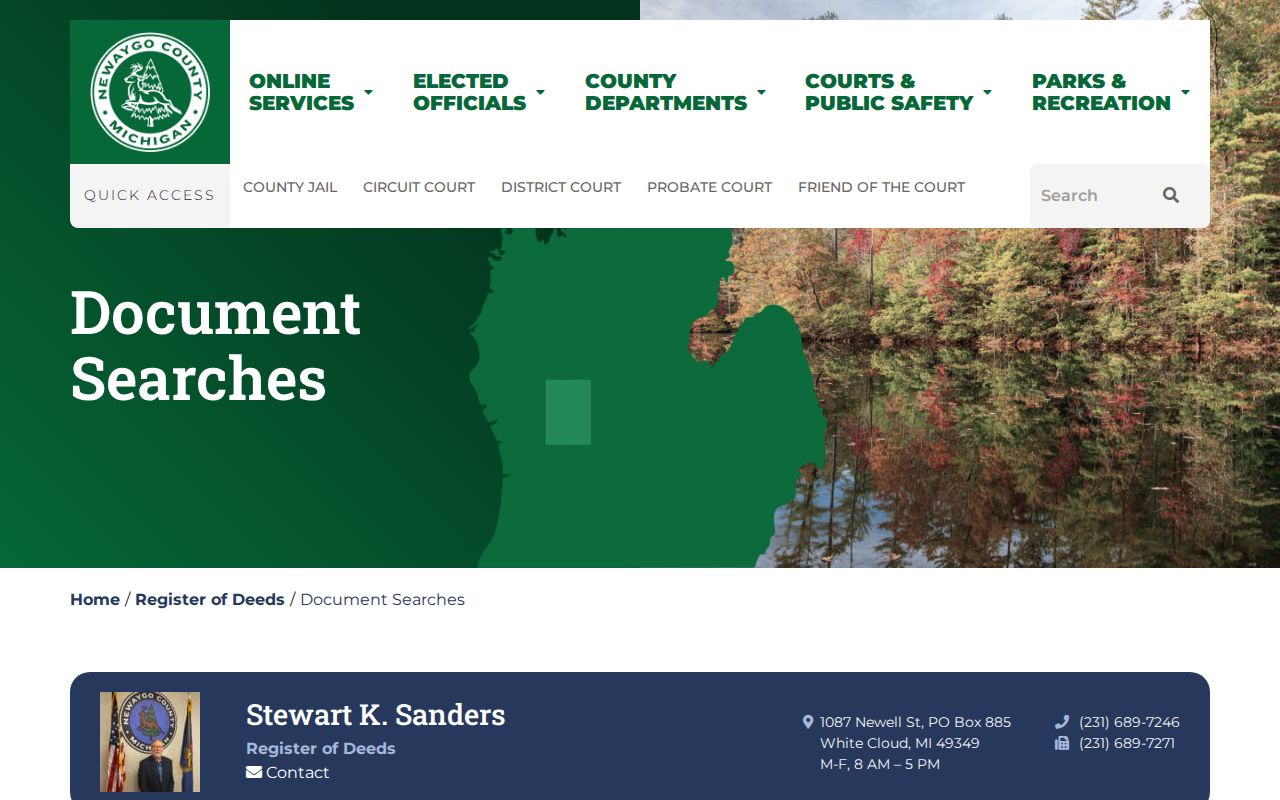
Deed access comes in two steps. The index check is free, but viewing or copying an instrument costs a fee. Three channels cover most needs. Public terminals at 1087 Newell Street run Tuesday through Thursday, 9 a.m. to 4 p.m. The general counter keeps longer hours, Monday through Friday, 8 a.m. to 5 p.m., but recording itself stops at 4 p.m. Staff let visitors run their own property records searches at the terminal. Mail requests work too. Name the exact record, include the fee, and enclose a self-addressed stamped envelope. New documents can reach the recorder by hand or by mail. The listed e-recording vendors offer a third route. Recording a fresh instrument, though, is separate work from pulling a deed that already exists.
Recorded, not guaranteed. Newaygo County deed records show accepted filings. They are not a title opinion, and unrecorded interests or defects may exist.